
Why the most meaningful parts of an estate are often the ones that never appear on a financial statement.
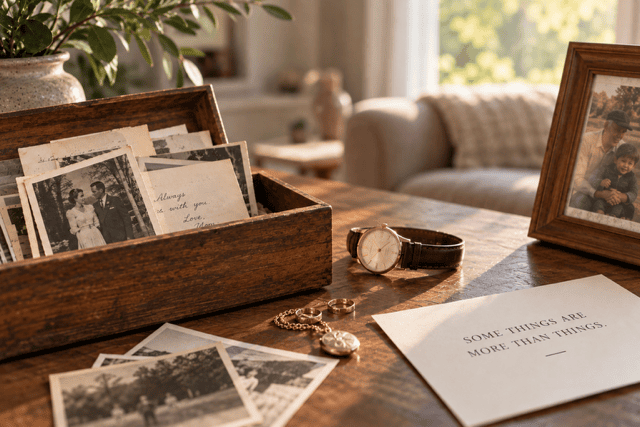
When a loved one dies, families eventually have to sort through practical questions: What happens to the house? Which accounts need to be handled? Who is responsible for the legal paperwork? But another part of settling an estate can be far more personal. Someone has to open the closet and decide what happens to the watch that belonged to a grandfather, the photographs tucked into a drawer, the handwritten recipe cards, the tools in the garage, the collection that took decades to build, or the chair that always sat in the same corner of the living room.
California Courts recognize personal belongings as part of what an estate plan can address, but the deeper question is whether the person who created the plan ever took the time to explain what those objects meant. Research published in 2026 looked specifically at loss-related objects among 250 bereaved adults and found that 83.2% of participants kept at least one emotionally significant object belonging to the person they lost. The finding illustrates something families already know intuitively: a physical object can represent far more than its resale value.
The Problem With “Just Divide Everything Equally”
One of the simplest phrases in estate planning can also be one of the most complicated: “My children will divide everything equally.” On paper, equal sounds fair. In practice, belongings rarely divide themselves neatly into equal pieces. One child may care deeply about the family photographs while another has always wanted the grandfather’s tools. One may have a sentimental connection to the house, while another would rather receive financial assets. If nobody knows what the deceased actually wanted, family members may be left to interpret silence at exactly the moment when emotions are already high.
This is where the difference between equal and fair becomes important. Fairness does not always mean assigning the same dollar amount to every person. Sometimes it means recognizing that a particular possession has a personal history with one family member that others do not share. A $75 necklace could mean more to one daughter than a $10,000 piece of furniture means to another. A box of old photographs might have almost no monetary value but could contain irreplaceable memories for the person who has spent years preserving family history. When those preferences are never discussed, even a carefully prepared estate plan can leave room for disagreement.
Why Family Assumptions Can Become Family Conflict
Families often believe they understand one another better than they actually do. Someone might say, “Everyone knows I want my daughter to have Mom’s jewelry,” or “My son knows what to do with the boat.” Those statements may feel reassuring while everyone is alive, but they are not the same as clearly communicating a plan. After a death, people can remember conversations differently, misunderstand what was intended, or discover that several family members believed the same object was meant for them.
There is also a psychological reason these disagreements can feel disproportionately painful. Grief changes the context in which ordinary decisions are made. A family member is not simply deciding who gets a piece of furniture; they may feel as though they are being asked to give up part of their connection to the person who died. Research on continuing bonds suggests that reminders of a deceased loved one can become part of how people maintain connection and reconstruct meaning after a loss. That does not mean families should keep everything. It means decisions about possessions can carry emotional consequences that are easy to underestimate.
The Things Worth Talking About Before They Become Decisions
A thoughtful estate plan can begin with a conversation long before anyone has to sort through a home. Think about the belongings that tell your family’s story: a wedding ring, military medals, family photographs, artwork, letters, a musical instrument, a collection, a vehicle, or a favorite piece of furniture. Then ask a different question than “What is this worth?” Ask, “Who has a connection to this, and why?” That question can reveal priorities that a financial inventory never would.
A family member may want a vehicle but not have the resources to maintain it. Several people may want the same property. A collection may have significant value that nobody realizes. A pet may need a caregiver and financial support. Digital photographs and videos may exist only in an online account. These situations are reminders that an estate is not simply a pile of assets waiting to be divided. It is a collection of decisions about people, property, responsibilities, and memories.
California Courts explain that a will can address property such as money, real property, a car, furniture, and other personal belongings, while a living trust can provide another way to manage and transfer assets when properly established and funded. The right approach depends on the individual’s circumstances and the type of property involved. For some families, a detailed plan for personal property can be especially useful because it removes uncertainty before emotions and competing assumptions enter the picture.
Your Estate Plan Can Say More Than “Who Gets What”
There is another layer of planning that is often overlooked: explaining the reasoning behind important decisions. A legal document is designed to accomplish legal objectives, but families can also benefit from additional communication that gives context. A personal letter, memorandum, inventory, or family conversation can explain why a particular heirloom is going to a particular person, identify the history behind an object, or simply tell loved ones why certain belongings matter.
This idea connects with an earlier Shoup Legal article, “August Is National Make-A-Will Month: Is a Will Enough in California?” A will can be an important part of an estate plan, but estate planning is broader than simply signing a document. The same principle applies here. Naming beneficiaries is important, but thoughtful planning also asks whether the people involved will understand what you intended and whether the structure of the plan actually fits the property and family circumstances.

Not Everything Has to Be Kept
Planning for sentimental property does not mean preserving every object forever. Perhaps an old piece of furniture has been in the family for generations but nobody wants it. Perhaps photographs can be digitized and shared before physical copies are distributed. Perhaps a collection should be sold and the proceeds divided rather than forcing someone to inherit something they cannot use. The goal is not to turn a home into a museum of everything you have ever owned. The goal is to make deliberate decisions while you still have the ability to make them.
When you identify what matters, explain your wishes, and give your family a clear path forward, you are doing more than transferring property. You are reducing the number of decisions your loved ones have to make while grieving. That can be especially meaningful when the possessions themselves are connected to memories and relationships that cannot simply be replaced.
A Legacy Is More Than a Balance Sheet
We tend to measure an estate in numbers because numbers are easy to organize. Homes have values. Bank accounts have balances. Investments have statements. But the things people remember most may not fit neatly into any of those categories. They may remember the watch their father wore every Sunday, the recipe their grandmother wrote by hand, the photographs their mother kept in a particular drawer, or the tools that remind them of the person who taught them how to build something.
Those objects cannot replace a person, and no estate plan can remove the pain of losing someone. But thoughtful planning can prevent unnecessary uncertainty from being added to that loss. By talking about meaningful possessions, documenting important wishes, and making sure your broader estate plan reflects your intentions, you give your family something valuable: clarity at a time when clarity may be difficult to find.
Frequently Asked Questions
Does an estate plan cover personal belongings?
Yes. Estate planning can address personal property such as furniture, jewelry, vehicles, collections, and other belongings. California Courts specifically notes that estate planning can help make sure personal belongings go where you want them to go. The appropriate method depends on the property and your overall plan.
Should I list every item I own?
Not necessarily. A complete inventory can be useful, but the most important items are often those with significant financial, sentimental, or practical importance. An estate planning professional can help determine what should be addressed specifically.
What happens if multiple family members want the same item?
If your wishes are unclear, family members may have to reach an agreement or rely on the applicable estate documents and California law. Identifying important possessions and discussing your wishes in advance can reduce the likelihood of conflict.
Can I leave sentimental items to specific people?
Estate planning can be structured to address specific property and beneficiaries, depending on the circumstances. Because different assets may be governed by different legal arrangements, specific gifts should fit into the larger estate plan.
What about pets?
Pets are part of the practical side of planning, too. Their care may require identifying a responsible caregiver, making financial arrangements, and coordinating those decisions with the rest of the estate plan.
When should I start planning for personal belongings?
There is rarely a good reason to wait until a major life event forces the issue. Starting while you are healthy gives you time to identify what matters, talk with your family, and make thoughtful decisions without the pressure of an immediate crisis.
Plan for What Matters
Estate planning is often described in terms of protecting wealth, avoiding probate, or deciding who inherits your assets. Those things matter, but they are only part of the picture. Your estate also contains the physical reminders of a life: the objects you collected, the things you built, the photographs you saved, and the belongings that became meaningful because of the people and experiences attached to them.
At Shoup Legal, we believe good estate planning starts with understanding what matters to you and the people you want to protect. If you have questions about how your personal property, family circumstances, and larger estate plan fit together, our team can help you explore your options and determine what kind of planning may make sense for your situation. You can also attend one of our educational estate planning workshops to learn more about the planning process and the questions you should be asking before making important decisions. Visit EstatePlanningWorkshop.org to see upcoming workshop dates and learn more.
Planning cannot make loss easier. But it can make the path forward clearer. And sometimes, the most meaningful thing you can leave your family is not another asset—it is the certainty that you thought about what mattered to them, too.